The moment a negotiation stops being rational
We love PhD dropouts and we love decision making science, so, naturally, we had to have Sam Liu on the podcast (Episode: YouTube | Spotify | Apple).
Hey there,
We love PhD dropouts and we love decision making science, so, naturally, we had to have Sam Liu on the podcast (Episode: YouTube | Spotify | Apple).
Sam is the founder of an AI company called Fergana Labs. Before that, he was doing a PhD at Stanford studying decision making.
We were curious what someone who studied decision making at that level actually learned, how they apply it to their negotiations, and how they apply it to their personal lives.
The surprising part was that many of Sam’s insights had less to do with elegant frameworks and more to do with how messy real decisions are.
The conversation ended up touching on startup risk, taxi negotiations in Thailand, poker, game theory, and why many people struggle to hold their ground in negotiations.
Listen to the full episode here (YouTube | Spotify | Apple), and here are a few ideas from Sam that stuck with us.
1. Big decisions rarely happen in a neat, rational moment
One of the things we asked Sam was how he decided to leave his PhD.
Did he sit down and run a structured decision analysis? A matrix? A pros and cons list?
He described something that will probably feel familiar to anyone who has made a big life decision.
“Things changed slowly, and then all at once.”
From the outside, dropping out of a PhD program or leaving a stable career can look sudden.
From the inside, it often builds quietly for a long time. You notice small signals. You feel a growing mismatch. Then one day the decision becomes obvious.
Looking back, he said, “I probably should have dropped out sooner.”
That line captures something many people experience. The signal is there long before the action.
2. Many risks are actually social risks
Sam shared a framework he learned from a mentor when thinking about starting a company.
Instead of asking “What if I fail?”, the mentor asked a different question.
“If the startup fails, what is the actual downside?”
Would anyone starve?
Would anyone become homeless?
For him, the answer was no.
The real downside was smaller. Maybe you earn less money than your friends. Maybe your house or car is not as impressive. Maybe people question your choices.
In other words, the risk was largely social.
Sam put it this way: “The moment you realize the only risk is social, you’re much more free to do the things you actually want to do.”
That framing applies to many career decisions, including negotiations. People often hold back not because the practical downside is catastrophic, but because they fear how they will be perceived.
3. Negotiation often becomes an emotional game
One of Sam’s examples came from something much simpler than salary negotiations: taxi rides in Thailand.
Unlike in the US, where prices are fixed, many rides involve negotiating the price directly with the driver.
Sam described how he approaches it using something similar to a binary search.
You start with a number. You see how the other person reacts. You adjust based on the signals you get.
But the interesting part is what happens emotionally.
The moment you push back on a price, the interaction changes. The other person may resist or push back. Now the challenge is not mathematical; it’s emotional.
Sam explained: “It’s not a rational game. It’s ‘can you hold the tension’.”
In many negotiations, the hardest part is not calculating the right ask. It’s staying steady while the other side reacts. That’s why we often joke with each other that half our job advising clients is to act as therapists: offering reassurance, lending a listening ear, sitting with our client’s discomfort.
4. Sometimes negotiations really are zero sum
A lot of negotiation advice emphasizes collaboration and mutual gains. Those ideas matter.
But Sam also made an important point about situations where value really is being divided.
Startup equity is one of them.
If one person gets more equity, someone else necessarily gets less.
In those cases, Sam believes people often soften too quickly.
“I feel like most people need to be more hard-lined,” he said. “More aggressive. They need to hold that tension and hold their ground.”
He was not dismissing collaboration. He was pointing out that some aspects of negotiation involve real tradeoffs.
When that’s true, clarity and conviction become important.
5. The person with conviction often shapes the outcome
One of the most interesting ideas Sam shared was about how people think about “fair value.”
Many negotiators look outward. They want to know the correct benchmark, the objective number, the market rate.
Sam sees negotiations differently.
He said many people approach negotiations by asking:
“What’s the fair price for what I’m offering?”
But in his mind, the question can also be framed differently.
“How can I conform the world to my vision?”
That doesn’t mean you’ll always get exactly what you want.
But it does mean that the outcome is not purely discovered. It’s also influenced by how firmly someone is willing to stand behind their claim.
6. Winning every negotiation is not the goal
Toward the end of the conversation, Sam brought up a famous concept from game theory: the prisoner’s dilemma.
In repeated versions of that game, the strategy that consistently performs best is called “tit for tat”.
You start by cooperating. If the other side cooperates, you continue cooperating. If they betray you, you respond in kind.
But the most interesting part of the strategy is this:
“You can never win against your counterparty,” Sam explained. “The best you can do is be at parity with them.”
That sounds counterintuitive at first. Why would the winning strategy avoid beating the other side?
Because the game is repeated.
In long-term relationships, cooperation tends to outperform strategies focused on maximizing short-term wins.
Sam extended that idea to life and relationships more broadly.
“What that says about life, if things in life are like this game, which a lot of things in life are, one of them being romantic relationships… you see so many people say, ‘I want to win the breakup’. But the best thing for you to do is be willing to lose and not care about winning.”
That’s one of the most beautiful hot takes we have heard on our podcast to-date.
This was one of our favorite conversations we’ve had thus far on Gentle Power! Listen to the full episode here: YouTube | Spotify | Apple.
And connect with Sam on LinkedIn and learn more about his company here: Fergana Labs website
Best,
Gerta & Alex
Co-founders, YourNegotiations.com
P.S. Are you job searching or have upcoming negotiations?
Book a free call with us, where we’ll learn more about your situation, offer some free tips, and explore if we’re a good fit to work together: https://calendly.com/alexhapki/call
P.P.S. Know someone interested in negotiations?
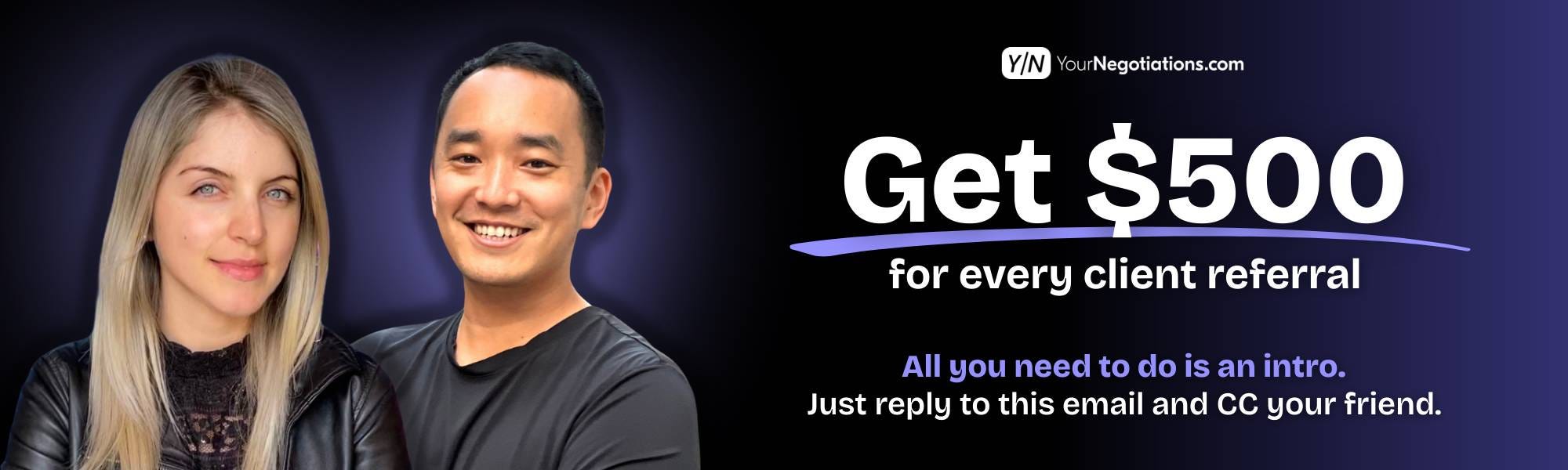
Send them our way and we’ll thank you with $500 for each person who becomes a client. No cap.
A quick intro or an email to alex@yournegotiations.com works.